Showing posts with label spacex. Show all posts
Showing posts with label spacex. Show all posts
Friday, June 04, 2010
congratulations SpaceX !
Today SpaceX launched the Falcon 9 into orbit on its first test flight. The rocket is capable of carrying up to seven people to orbit in the Dragon capsule. SpaceX is a private company that didn't even exist eight years ago and in a couple years they will be delivering people to the international space station - and the Bigelow stations due to be launched in the next few years. It's a pretty good day.
Monday, February 04, 2008
Moving the Goalposts
A few days ago, I wrote a blog post directed at Mark Whittington that said:
So yes, by all means, let us hold SpaceX to the same standard as NASA - or rather, let us hold NASA to the same standard as SpaceX. Let NASA pay for its mistakes out of its own pocket without dinging the taxpayers for its failures... what's that? NASA doesn't have money of its own? Then perhaps we should hold NASA to the same standards to which NASA holds Rocketplane/Kistler.
Whittington goes on to say:
There is no double standard at work here. SpaceX used its own money for the Falcon-1 tests. NASA is using taxpayers' money for the obviously flawed-from-before-starting Ares. The difference is not subtle.Mark Whittington replied that
Technically, he is correct that SpaceX used private money for Falcon 1 tests. But it also is using public money to develop the Falcon 9/Dragon launch system. So, using Robot Guy's logic, one ought to gove SpaceX the same benefit of a doubt--or lack there of--as NASA.Perhaps I ought to have included more of Mark Whittington's original statement, as based on his reply one might think I was making an apples-to-oranges comparison. Here's the full paragraph from Whittington's original post:
Even in the commercial area, technical problems crop up. SpaceX's Falcon 1 have had two launch failures, for example. SpaceX's engineers have ascertained the causes of these failures and are fixing them. It is noted that no one who is having Internet vapors over the Ares is having the same over the Falcon. There seems to be, perhaps because of a double standard, more of an understanding that problems will occur in rocket development in the private sector than at NASA.Clearly Mark was comparing SpaceX's (self funded) Falcon 1 launches to NASA's (taxpayer funded) work on Ares. He was not referring to the Falcon 9/Dragon launch system (and thus, neither was I), which admittedly is being partially funded by NASA and thus by taxpayers. He was referring to Falcon 1.
So yes, by all means, let us hold SpaceX to the same standard as NASA - or rather, let us hold NASA to the same standard as SpaceX. Let NASA pay for its mistakes out of its own pocket without dinging the taxpayers for its failures... what's that? NASA doesn't have money of its own? Then perhaps we should hold NASA to the same standards to which NASA holds Rocketplane/Kistler.
Whittington goes on to say:
...the bald, unsupported statement "obviously flawed from the start Ares" (I wish someone would offer some actual evidence to support that)I had left the support for that statement out of my original post because I thought it was so obvious that further explanation was unnecessary. One could look at the Aviation Week article discussing the thrust oscillation problems, which are going to happen with any solid rocket motor first stage. One could point to the weight problems and schedule slippage. One could keep going, but I suspect that anyone who has been following NASA closely over the last four years would have to know about the problems with Ares/Orion. Any other assumption beggars belief.
Friday, February 01, 2008
what's in it for me?
A few weeks ago Leonard David pointed out a National Science Board report which among other things stated that
Well, it might be a kick in the head for NASA, but the U.S. space agency is not synonymous with "space", and the lack of enthusiasm for increased funding for NASA is not synonymous with a lack of enthusiasm for space projects.
At one time, Americans could be convinced that NASA == space, but that time is long past. When the Collier's articles by Wernher von Braun, Willy Ley, Fred Whipple, and others were published in 1952-54, people paid attention. When the Russians launched Sputnik, people sat up and took notice. And then came Kennedy's speech:
Well, that got people excited. And that race to the moon gave people more than the impression that NASA == space. It gave them hope - hope that one day they too could go to space. How many kids went into science and engineering because of the work that NASA did in the eight years following the Kennedy speech at Rice university? I can't quantify that, but I bet it was a lot. And, in the years during and immediately following the Apollo missions, people were excited about the apparent progress, the seemingly inexorable movement of man into space.
2001: a Space Odyssey showed routine flights into space to a gigantic wheel-shaped space station, multiple bases on the moon, and a manned voyage to Jupiter. In 1968 these seemed plausible enough, certainly not laughable. There were proposals to build enormous space colonies ("L5 by 95!"), and it seemed as though nothing could stop us. We were going to be a spacefaring civilization, and in a hurry. In the 1960s and 1970s kids could realistically dream of a career as an astronaut.
Thirty-five years after the last man set foot on the moon, it seems that we are further than ever from becoming a spacefaring civilization - that is, at least with NASA as a driving force. NASA is in fact going backwards, struggling to recover ground that was won nearly four decades ago after having wasted the intervening period going around in circles. A kid today has a greater chance of winning the Powerball lottery than of being a NASA astronaut. Why bother doing something as hard as science or engineering if the chance of a payoff is so remote?
Why is support for NASA so low? Perhaps it is because one can only rest on one's laurels for so long. One needs to actually do something in order to engage the public and convince them that you are doing something worth their tax dollars. And, if all you are doing is putting a handful of government employees into low earth orbit a few times a year, then convincing people that you are indeed doing something worthwhile is a pretty tough sell.
I have to feel sorry for Damaris B. Sarria. She writes a blog entitled How I Am Becoming An Astronaut - and she's doing it by working for NASA. She's not in the astronaut corps yet, and it is sad to say but if NASA's present course is continued then she will never become an astronaut. The agency already has far more astronauts than it will need for the shuttle program, some of whom will never be launched into space. By the time that the Ares series of boosters is finally developed - the schedule slips by more than a year every year - NASA will have had to defend its funding and indeed the entire raison d'etre of US Space Exploration Policy through several presidential administrations and congresses. At the current rate of schedule slippage, budget woes, and obvious problems with the Ares it is a crapshoot whether NASA will even exist in 2020, never mind be sending anyone to the moon.
But, as I said, NASA is not "space". Robert Bigelow has already done something that no government space agency has ever done: he has two space stations in orbit simultaneously, right now. Elon Musk of SpaceX has developed two completely new rocket engines and begun launching rockets, from a standing start five years ago, using the amount of money that NASA consumes in about eleven days. Burt Rutan has put two people into space (only spending about what NASA spends every 14 hours), and is developing a bigger craft capable of carrying paying passengers into space as early as next summer. Google has put up a $30 million prize for a lunar robotic rover, and private companies are lining up around the block to compete for that prize. There are over 80 private space companies at my last count. And even in the realm of government space activity, the cool cutting-edge stuff isn't being done by NASA; it is being done by the Pentagon in partnership with the Space Frontier Foundation.
Support for space hasn't died; it has shifted from an increasingly irrelevant NASA to the private sector. There is a good reason for that. People can see that the private sector work in space has potential to offer them. There's something in it for them - they once again have the possibility of going to space themselves. They have the possibility of making money on space. And, they don't need to go through an ossified government space agency whose glory days were over before most people alive today were even born. It is no wonder that support for increasing NASA's budget is so low.
Scientific research ranks about on a par with mass transit (38%) and well ahead of space exploration (14%) and assistance to foreign countries (10%) in the proportion of the U.S. population favoring increased spending.Leonard David called this a "kick in the head for space fans".
Well, it might be a kick in the head for NASA, but the U.S. space agency is not synonymous with "space", and the lack of enthusiasm for increased funding for NASA is not synonymous with a lack of enthusiasm for space projects.
At one time, Americans could be convinced that NASA == space, but that time is long past. When the Collier's articles by Wernher von Braun, Willy Ley, Fred Whipple, and others were published in 1952-54, people paid attention. When the Russians launched Sputnik, people sat up and took notice. And then came Kennedy's speech:
Well, that got people excited. And that race to the moon gave people more than the impression that NASA == space. It gave them hope - hope that one day they too could go to space. How many kids went into science and engineering because of the work that NASA did in the eight years following the Kennedy speech at Rice university? I can't quantify that, but I bet it was a lot. And, in the years during and immediately following the Apollo missions, people were excited about the apparent progress, the seemingly inexorable movement of man into space.
2001: a Space Odyssey showed routine flights into space to a gigantic wheel-shaped space station, multiple bases on the moon, and a manned voyage to Jupiter. In 1968 these seemed plausible enough, certainly not laughable. There were proposals to build enormous space colonies ("L5 by 95!"), and it seemed as though nothing could stop us. We were going to be a spacefaring civilization, and in a hurry. In the 1960s and 1970s kids could realistically dream of a career as an astronaut.
Thirty-five years after the last man set foot on the moon, it seems that we are further than ever from becoming a spacefaring civilization - that is, at least with NASA as a driving force. NASA is in fact going backwards, struggling to recover ground that was won nearly four decades ago after having wasted the intervening period going around in circles. A kid today has a greater chance of winning the Powerball lottery than of being a NASA astronaut. Why bother doing something as hard as science or engineering if the chance of a payoff is so remote?
Why is support for NASA so low? Perhaps it is because one can only rest on one's laurels for so long. One needs to actually do something in order to engage the public and convince them that you are doing something worth their tax dollars. And, if all you are doing is putting a handful of government employees into low earth orbit a few times a year, then convincing people that you are indeed doing something worthwhile is a pretty tough sell.
I have to feel sorry for Damaris B. Sarria. She writes a blog entitled How I Am Becoming An Astronaut - and she's doing it by working for NASA. She's not in the astronaut corps yet, and it is sad to say but if NASA's present course is continued then she will never become an astronaut. The agency already has far more astronauts than it will need for the shuttle program, some of whom will never be launched into space. By the time that the Ares series of boosters is finally developed - the schedule slips by more than a year every year - NASA will have had to defend its funding and indeed the entire raison d'etre of US Space Exploration Policy through several presidential administrations and congresses. At the current rate of schedule slippage, budget woes, and obvious problems with the Ares it is a crapshoot whether NASA will even exist in 2020, never mind be sending anyone to the moon.
But, as I said, NASA is not "space". Robert Bigelow has already done something that no government space agency has ever done: he has two space stations in orbit simultaneously, right now. Elon Musk of SpaceX has developed two completely new rocket engines and begun launching rockets, from a standing start five years ago, using the amount of money that NASA consumes in about eleven days. Burt Rutan has put two people into space (only spending about what NASA spends every 14 hours), and is developing a bigger craft capable of carrying paying passengers into space as early as next summer. Google has put up a $30 million prize for a lunar robotic rover, and private companies are lining up around the block to compete for that prize. There are over 80 private space companies at my last count. And even in the realm of government space activity, the cool cutting-edge stuff isn't being done by NASA; it is being done by the Pentagon in partnership with the Space Frontier Foundation.
Support for space hasn't died; it has shifted from an increasingly irrelevant NASA to the private sector. There is a good reason for that. People can see that the private sector work in space has potential to offer them. There's something in it for them - they once again have the possibility of going to space themselves. They have the possibility of making money on space. And, they don't need to go through an ossified government space agency whose glory days were over before most people alive today were even born. It is no wonder that support for increasing NASA's budget is so low.
Monday, December 10, 2007
Space Video of the Day - 071210
Earlier today, SpaceX released a monster update of their activities. Included with the update were links to several videos; unfortunately, whether through incorrect URLs in the update or overloading of their servers, I was unable to watch any of their videos. What I do have is today's Space Video of the Day, taken about a month ago at SpaceX's BFTS facility (the acronym officially stands for Big Falcon Test Stand, however one would be excused for thinking that the original meaning of the F was something different, as the BFTS stands 238 feet tall). This is a full 170-second test of their Merlin 1-C engine, which will power all Falcon-9 rockets in the future.
It should be noted that the amount spent by SpaceX on developing the Falcon-1, Falcon-9, the Dragon (seven-member crew capsule), several completely new rocket engines, the BFTS, and their facilities in California, Texas, Florida, and the equatorial Pacific since the company's inception six years ago totals about what NASA spends every week and a half: that's the difference between a guy (Elon Musk) using his own money, and a government agency frittering away taxpayers' dollars.
Space Video of the Day Archive
It should be noted that the amount spent by SpaceX on developing the Falcon-1, Falcon-9, the Dragon (seven-member crew capsule), several completely new rocket engines, the BFTS, and their facilities in California, Texas, Florida, and the equatorial Pacific since the company's inception six years ago totals about what NASA spends every week and a half: that's the difference between a guy (Elon Musk) using his own money, and a government agency frittering away taxpayers' dollars.
Space Video of the Day Archive
Friday, June 15, 2007
news from SpaceX
SpaceX has posted the results of their DemoFlight 2 review. In all, eight anomalies were found, one of which (the upper stage control anomaly, likely caused by slosh in the LOX tank) led to the uncontrollable roll of the craft and the subsequent loss of the rocket. Upper stage slosh baffles, which will be included on all future launches, should solve this problem.
Tuesday, March 20, 2007
Same Time, Same Station
Here's the update from SpaceX's Elon Musk:
Updates:
3:40pm PDT. The SpaceX Updates page now says that the launch has been moved to 5:05 pm PDT. The webcast is supposed to start an hour before launch, so I'll check back in with an update in half an hour.
4:15 pm PDT, T-minus 50 minutes. The webcast has started. Fuel and liquid oxygen loading is about 40% complete.
T-minus 33 minutes. LOX loading is complete.
T-minus 15 minutes. Looks like everything is proceeding normally. The launch team is working its way through the countdown checklist. All stations are ready for launch.
T-minus 8 minutes. I've been having trouble getting a screenshot of the rocket, so I'm going to try something here. if this works, then the webcast will also be broadcast here on my blog. Whoops, that sucked. Anyone know why I can't get a frozen screen capture? When I try to do a capture, the live feed comes through rather than a screen cap. Weird.
Ah well. Anyhow, the strongback arm has been retracted. Keep your fingers crossed.
T-minus 2 minutes. The clock keeps ticking, there was a warning on their LOX pressure, but it looks like it isn't a concern.
T-minus 1 minute. My heart is pounding.
LIFTOFF! GO BABY GO! Whoa... wtf... abort?
Geez... they started the engines, and then immediately aborted. The rocket didn't even lift off the pad. At least they didn't blow it up or lose any hardware.
5:12 pm PDT. The vehicle has been put into a safe mode, and they are now determining what happened. No idea yet whether they will try again today.
5:17 pm PDT. It sounds like they are going to reset the clock to T-minus 11 minutes and try again.
5:35 pm PDT. They are looking to reset the clock to T-minus 16 minutes at 5:54 PDT, for a new launch time of 6:10 pm PDT (0110 Greenwich).
5:55 pm PDT, T-minus 15 minutes. The countdown has restarted.
T-minus 13 minutes. Everything is go, they are cleared for launch. Hopefully this third time's the charm...
T-minus ten minutes. Terminal count has started.
T-minus 4 minutes. I'm going to sit back and watch now, no more updates until after the launch.
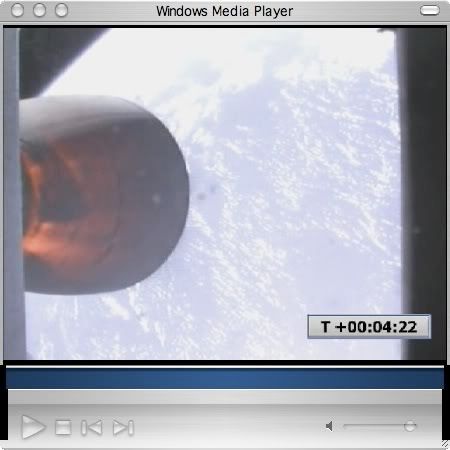
T+3 minutes or so. The launch went off well, they had separation of first and second stages, and they definitely got into space. Then the webcast feed died. At the time the feed died, the engine bell was getting red hot. Hopefully they didn't have a burn-through.
7:18 pm PDT. Daniel Schmelzer reports that Elon Musk confirms that telemetry on the rocket was lost at T+5:05. The rocket did not make its intended orbit. Dang, double dang. However, the rocket did make it into space, successfully sepearated first and second stages, and the fairing did successfully separate. I'll post another update when I find out what happened to the rocket.
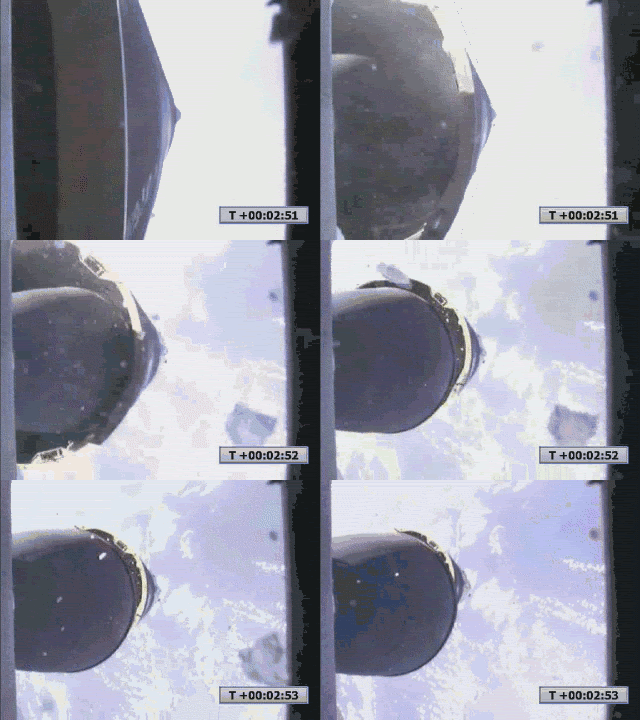
Upperdate: Via Space Liberates Us! comes this gif of the first stage separation. It looks like the first stage impacted the engine bell on the second stage.
Via Kimbal Musk (Elon's brother) comes this image of the second stage engine bell four minutes into the launch. Note the red-hot glow on the engine bell; I don't have access to SpaceX's test data, but I'm pretty sure that such a glow is not nominal, nor a good sign at all.
According to Elon, they did achieve 300 kilometers, which is well beyond the edge of space. It is not known at this time if the rocket achieved a very low eccentric orbit or if it crashed halfway around the world. I'll update as I find out. (Update to the update: it looks like it ended up crashing in the Pacific.)
I just downloaded the hi-res video of the launch, and I'm going to post it on YouTube. As soon as that upload is complete, I'll post the video of the launch here.
Uppestdate: Here's the video of the launch.
The abort that occurred a few minutes before T-0 was triggered by our ground control software. It commanded a switchover of range telemetry from landline to radio, which took place correctly, however, because of the hardware involved, this transition takes a few hundred milliseconds. Before it had time to complete, our system verification software examined state and aborted.You can bet that I'll be here, watching the video and liveblogging.
Our simulations done beforehand all passed, because the simulator did not account for a hardware driven delay in the transition. We considered putting the vehicle into a safe state yesterday and updating the ground control software to make the very minor fix needed, but the safer course of action was to stand down.
Yesterday afternoon and evening (Kwaj time), our launch team updated the software to address the timing issue and verified that there were no similar problems elsewhere. We ran the software through several simulated countdowns and then once again with the rocket and range in the loop.
All systems are now go for launch with T-0 at 4pm California time today (Tues).
Updates:
3:40pm PDT. The SpaceX Updates page now says that the launch has been moved to 5:05 pm PDT. The webcast is supposed to start an hour before launch, so I'll check back in with an update in half an hour.
4:15 pm PDT, T-minus 50 minutes. The webcast has started. Fuel and liquid oxygen loading is about 40% complete.
T-minus 33 minutes. LOX loading is complete.
T-minus 15 minutes. Looks like everything is proceeding normally. The launch team is working its way through the countdown checklist. All stations are ready for launch.
T-minus 8 minutes. I've been having trouble getting a screenshot of the rocket, so I'm going to try something here. if this works, then the webcast will also be broadcast here on my blog. Whoops, that sucked. Anyone know why I can't get a frozen screen capture? When I try to do a capture, the live feed comes through rather than a screen cap. Weird.
Ah well. Anyhow, the strongback arm has been retracted. Keep your fingers crossed.
T-minus 2 minutes. The clock keeps ticking, there was a warning on their LOX pressure, but it looks like it isn't a concern.
T-minus 1 minute. My heart is pounding.
LIFTOFF! GO BABY GO! Whoa... wtf... abort?
Geez... they started the engines, and then immediately aborted. The rocket didn't even lift off the pad. At least they didn't blow it up or lose any hardware.
5:12 pm PDT. The vehicle has been put into a safe mode, and they are now determining what happened. No idea yet whether they will try again today.
5:17 pm PDT. It sounds like they are going to reset the clock to T-minus 11 minutes and try again.
5:35 pm PDT. They are looking to reset the clock to T-minus 16 minutes at 5:54 PDT, for a new launch time of 6:10 pm PDT (0110 Greenwich).
5:55 pm PDT, T-minus 15 minutes. The countdown has restarted.
T-minus 13 minutes. Everything is go, they are cleared for launch. Hopefully this third time's the charm...
T-minus ten minutes. Terminal count has started.
T-minus 4 minutes. I'm going to sit back and watch now, no more updates until after the launch.
T+3 minutes or so. The launch went off well, they had separation of first and second stages, and they definitely got into space. Then the webcast feed died. At the time the feed died, the engine bell was getting red hot. Hopefully they didn't have a burn-through.
7:18 pm PDT. Daniel Schmelzer reports that Elon Musk confirms that telemetry on the rocket was lost at T+5:05. The rocket did not make its intended orbit. Dang, double dang. However, the rocket did make it into space, successfully sepearated first and second stages, and the fairing did successfully separate. I'll post another update when I find out what happened to the rocket.
Upperdate: Via Space Liberates Us! comes this gif of the first stage separation. It looks like the first stage impacted the engine bell on the second stage.
Via Kimbal Musk (Elon's brother) comes this image of the second stage engine bell four minutes into the launch. Note the red-hot glow on the engine bell; I don't have access to SpaceX's test data, but I'm pretty sure that such a glow is not nominal, nor a good sign at all.
According to Elon, they did achieve 300 kilometers, which is well beyond the edge of space. It is not known at this time if the rocket achieved a very low eccentric orbit or if it crashed halfway around the world. I'll update as I find out. (Update to the update: it looks like it ended up crashing in the Pacific.)
I just downloaded the hi-res video of the launch, and I'm going to post it on YouTube. As soon as that upload is complete, I'll post the video of the launch here.
Uppestdate: Here's the video of the launch.
Monday, March 19, 2007
Private Orbital Rocket Launch Today
It looks like SpaceX is going to launch their Falcon 1 rocket today at 4pm Pacific time (11PM GMT). That is, assuming there are no last minute concerns, in which case the launch will be postponed. The launch will be webcast live starting an hour before the launch. Good luck to Elon Musk and the rest of the SpaceX team - I'll be watching with fingers crossed.
Updates:
T-minus 40 minutes?. The webcast is running. For some strange reason, the clock displayed at the lower right is stuck on T+00:00:29, even though the rocket is obviously in a T-minus configuration (i.e. on the ground). It looks like there is a light breeze there, as the trees around the pad are rustling a bit and clouds are passing by overhead. There is no sound right now. Hopefully that'll change.
T-minus 20 minutes?. SpaceX is still showing video of the rocket sitting on the pad with no sound. There have been no views from inside the control center, no voiceovers, nothing. If it wasn't for the clouds passing by overhead, I would think that my video player had frozen. There have been no further updates from either Elon Musk or Kimbal Musk all day, so I'm assuming that the launch is still going ahead.
T-minus 10 minutes?. Still no change in view, no sound, no indication whether the launch is actually going ahead, just clouds placidly passing by overhead. It looks like a beautiful morning on Kwajalein atoll, although breezy. Hopefully the wind isn't a problem for the launch.
T-minus whoknows. The rocket was scheduled for liftoff five minutes ago. Still no countdown, no audio, no information, no update on SpaceX's website, just a rocket sitting on a pad boiling off oxygen.
4:13 PDT. The rocket was scheduled to launch 13 minutes ago. Finally there's some sound!
4:20 PDT. Launch Director announces T-minus 25 minutes and counting.
T-minus 18 minutes. The countdown clock is finally operating, and it sounds like they are repressurizing the Helium in the top stage.
T-minus 15 minutes. Various flight control operators reporting Green across the board, countdown checklist proceeding. They are not planning on having any more holds, and it looks like they are ready for launch.
T-minus 10 minutes. It sounds like everything is proceeding normally, Terminal Count has started.
T-minus 8 minutes. The strongback has moved out of the way.
T-minus 4 minutes. Everything seems to be moving along smoothly.
T-minus 1:25. There is a terminal count abort, Looks like they are going to abort the launch.
Stuck at T-minus 1:02, 4:53 pm PDT. No word yet on what caused the abort, or whether they are going to reset the clock and try again.
4:54 pm PDT. They are going to take the next ten minutes figuring out why there was an abort, but from the sounds of it there was something in their flight path downrange that triggered the abort. (Probably some idiot in a boat.)
5:10 pm PST. The launch has been scrubbed for the day. Dang. I'll post the reason for the scrub as soon as Elon Musk updates the SpaceX website. They are now offloading the propellant and Helium from the rocket. It looks like the delay will be a day or two.
Updates:
T-minus 40 minutes?. The webcast is running. For some strange reason, the clock displayed at the lower right is stuck on T+00:00:29, even though the rocket is obviously in a T-minus configuration (i.e. on the ground). It looks like there is a light breeze there, as the trees around the pad are rustling a bit and clouds are passing by overhead. There is no sound right now. Hopefully that'll change.
T-minus 20 minutes?. SpaceX is still showing video of the rocket sitting on the pad with no sound. There have been no views from inside the control center, no voiceovers, nothing. If it wasn't for the clouds passing by overhead, I would think that my video player had frozen. There have been no further updates from either Elon Musk or Kimbal Musk all day, so I'm assuming that the launch is still going ahead.
T-minus 10 minutes?. Still no change in view, no sound, no indication whether the launch is actually going ahead, just clouds placidly passing by overhead. It looks like a beautiful morning on Kwajalein atoll, although breezy. Hopefully the wind isn't a problem for the launch.
T-minus whoknows. The rocket was scheduled for liftoff five minutes ago. Still no countdown, no audio, no information, no update on SpaceX's website, just a rocket sitting on a pad boiling off oxygen.
4:13 PDT. The rocket was scheduled to launch 13 minutes ago. Finally there's some sound!
4:20 PDT. Launch Director announces T-minus 25 minutes and counting.
T-minus 18 minutes. The countdown clock is finally operating, and it sounds like they are repressurizing the Helium in the top stage.
T-minus 15 minutes. Various flight control operators reporting Green across the board, countdown checklist proceeding. They are not planning on having any more holds, and it looks like they are ready for launch.
T-minus 10 minutes. It sounds like everything is proceeding normally, Terminal Count has started.
T-minus 8 minutes. The strongback has moved out of the way.
T-minus 4 minutes. Everything seems to be moving along smoothly.
T-minus 1:25. There is a terminal count abort, Looks like they are going to abort the launch.
Stuck at T-minus 1:02, 4:53 pm PDT. No word yet on what caused the abort, or whether they are going to reset the clock and try again.
4:54 pm PDT. They are going to take the next ten minutes figuring out why there was an abort, but from the sounds of it there was something in their flight path downrange that triggered the abort. (Probably some idiot in a boat.)
5:10 pm PST. The launch has been scrubbed for the day. Dang. I'll post the reason for the scrub as soon as Elon Musk updates the SpaceX website. They are now offloading the propellant and Helium from the rocket. It looks like the delay will be a day or two.
Saturday, March 17, 2007
SpaceX Falcon Engine Test
SpaceX just conducted a successful engine static fire test. The test went perfectly, and it looks like the Falcon could be launched as early as Monday. Here is some video of the test, taken from medium range:
And here is a closeup view of the engine test, taken with a high-speed camera:
And here is a closeup view of the engine test, taken with a high-speed camera:
Subscribe to:
Posts (Atom)